Essential Guitar Chords for All Levels
Right and left-handed charts- Essential guitar chords for right-handed beginners
- Essential guitar chords for left-handed beginners
These chords are an absolute 'must' for all beginners. They will set you on the right path and enable you to play the easiest of chords in preparation for the next learning phase.
Once you become proficient at playing these chords, it's time to move on to a more comprehensive range of chords including barre chords, power chords, moveable chords, and we include enough chord theory along with easy formulas and examples to help you understand how chords are formed.
Popular Chord Types
Barre chords
The most common open-chord shapes - E shapes and A shapes, as well as the C shape and popular F shapePower chords
Learn the most common power chords with the root note on the 6th string and the root note on the 5th string. They are simple, strong‑sounding two‑note shapes, and they work beautifully anywhere on the fretboard. If you enjoy playing rock, punk, metal, or anything with a driven tone, learning power chords is essential. They’re easy, fun, and your distortion will sound much cleaner too.
Natural Key Chords - A, B, C, D, E, F, G
Here you will find chord charts to the most widely played chords from each of the 7 natural keys including: M, 7, m, m7, maj7, sus4, 7sus4, 6, m6, 9, m9, maj9, 6/9, 7+9, 7-9, aug, 7+5, dim, dim7, -5, 7-5, 9-5, 11, 13.
Movable Chords
These are chords that can be played over the entire fretboard using the same shape. They utilize open chords and barre chords in a variety of shapes depending on where the root note is located.
There are positions for the root note on the 4th, 5th and 6th strings as well as the 5th note of the chord on the 5th and 6th strings. These chords are invaluable... they allow for variation and greater flexibility in your playing style. They are ideal for jazz players and anyone wanting to add a new dimension to their sound and playing style.
You can now play chords that are in closer proximity to each other rather than playing one chord on the first few frets, then having to swing by fret 7 for the next chord, fret 2 for the following chord etc.
To play these chords, you must know or be able to calculate the notes on the fretboard, or at the very least the fretted notes on the 5th and 6th strings. Makes sure you look at the guitar notes page for a full run-down of all the notes on the fretboard as well as some handy tips to help calculate the notes with my simple 5554 rule.
About the Charts...
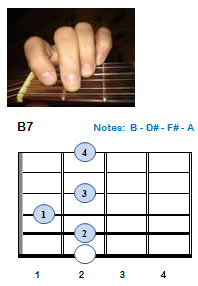
Each chord type has 12 chords, with each chord being displayed in 3 different positions on the fretboard. The chord charts display the finger positions for each chord as well as displaying the notes of the chord including fret positions, barre chords, open positions etc.
Our Horizontal Charts are displayed in a natural playing position, therefore you read the chart as if you are looking down on the guitar while you are playing. The nut of the guitar is on the left of the chart and the bridge is on the right with the opposite for left-handers. Once you get used to the charts, they become very easy to read. You no longer have to look at a chord chart and twist it round for it to make sense... you play it as you see it.
PS. The B7 chord displayed here includes an optional note (white circle) which is not normally played as shown in the picture - it would be written as a slash chord - B7/F# (B7 leading with F# bass note).
Although F# is part of the B7 chord (B-D#-F#-A), you normally lead each chord on the tonic which is B in this case.
If you do play the optional note, you will need to cover the 5th and 6th string with your second finger - a little awkward at first but much easier with practice.
You will need Adobe Reader (the latest version is recommended) installed on your computer in order to open and read all the free chord charts that you download. You can obtain Adobe Reader by visiting their website. (a new window will open so you can download it without leaving this page).