Building Chords
Scales and chord formulasBuilding chords relies on 2 main factors:
- Knowledge of Scales: the foundation of notes for building each chord.
- Knowledge of Chord Formulas: a formula to apply to any given scale and construct each chord by substituting the notes of the scale into the formula.
Just to add a little spice to our knowledge of scales we have included the following table concerning Scale Degrees which defines each note in a scale in several different ways. It is good practice to become familiar with all of these terms, as you will see them used often... very handy to know.
Scale Degrees
| Scale Degree | I | ii | iii | IV | V | vi | vii | VII |
|---|---|---|---|---|---|---|---|---|
| Name | Tonic | Supertonic | Mediant | Subdominant | Dominant | Submediant | Leading Tone/Subtonic | Octave (Upper Tonic) |
| Interval | First | Second | maj or min Third | Fourth | Fifth | maj or min Sixth | maj or min Seventh | Perfect Octave |
| Note | Root | 2nd | 3rd | 4th | 5th | 6th | 7th | Octave (Root) |
A Scale Degree is the name given to a particular note in a scale in relation to the tonic (first note), which is the most important note in a scale. They are defined by Roman Numerals, names, intervals, or notes of the scale. In the following table, we will refer to each note as numbered notes of the scale, i.e., 1st, 2nd, 3rd, etc.
If we think of the Tonic as the tonal center of a scale- Supertonic and Subtonic are each one whole step above and below the Tonic
- Mediant and Submediant are each a third above and below the Tonic
- Dominant and Subdominant are each a fifth above and below the Tonic
- Please Note:
Subtonic is used when the interval between it and the tonic in the upper octave is a whole step, eg., 7 chord
Leading Tone is used when the interval between it and the tonic in the upper octave is a half-step, e.g., maj7 chord
Major Scales: Foundation for Chord Building
When determining any type of chord, we need to know the major scale relating to each respective chord, e.g., if we need to calculate any type of C chord whether it be C Major, C minor, Cdim etc., we need to know the notes in a C Major Scale. The same applies to all other chords.
| Major Scale | 1st | 2nd | 3rd | 4th | 5th | 6th | 7th |
|---|---|---|---|---|---|---|---|
| A | A | B | C# | D | E | F# | G# |
| A# | A# | B# | Cx | D# | E# | Fx | Gx |
| B♭ | B♭ | C | D | E♭ | F | G | A |
| B | B | C# | D# | E | F# | G# | A# |
| C | C | D | E | F | G | A | B |
| C# | C# | D# | E# | F# | G# | A# | B# |
| D♭ | D♭ | E♭ | F | G♭ | A♭ | B♭ | C |
| D | D | E | F# | G | A | B | C# |
| D# | D# | E# | Fx | G# | A# | B# | Cx |
| E♭ | E♭ | F | G | A♭ | B♭ | C | D |
| E | E | F# | G# | A | B | C# | D# |
| F | F | G | A | B♭ | C | D | E |
| F# | F# | G# | A# | B | C# | D# | E# |
| G♭ | G♭ | A♭ | B♭ | C♭ | D♭ | E♭ | F |
| G | G | A | B | C | D | E | F# |
| G# | G# | A# | B# | C# | D# | E# | Fx |
| A♭ | A♭ | B♭ | C | D♭ | E♭ | F | G |
Building Chords - Observations from the table above:
- The major scales in lighter colors are not commonly used i.e., we would most likely use the B♭ Major Scale rather than the A# Major Scale; C# instead of D♭; E♭ instead of D#; F# instead of G♭, and A♭ instead of G#.
- x is another symbol for double sharp or ##
- We haven't included the 8th note of the scale, as it is the same as the first note or Tonic, except it is 1 Octave higher. If we were referring to the name of the Scale Degree, it would be called Octave or Upper Tonic.
- The C Major Scale has no sharps or flats.
Chord Formulas: Constructing Chords from Scales
There are a multitude of chord types and extensions. Each type of chord has a formula which tells us which notes of the major scale make up each chord.
When building chords, the first letter of the chord tells us the major scale we will apply the formula to, e.g.,- a Dm chord will use the D major scale as the basis to which a minor chord formula is applied;
- a Cmaj7 will use a C major scale as the basis to which a maj7 chord formula is applied;
- a Bm7 will use a B major scale as the basis to which a m7 chord formula is applied, etc.
The following is a list of the most common chord types.
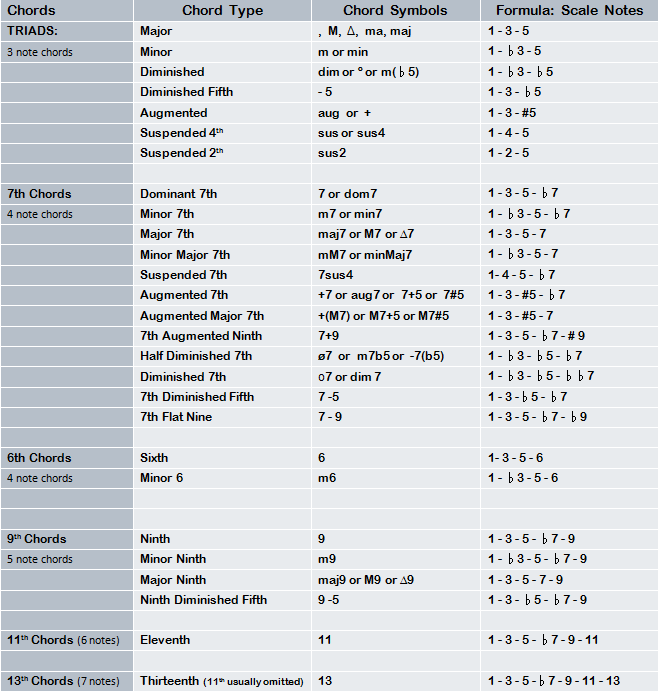
Chord Building Examples
Once you know your major scales, and the formula for each chord type, you can work out almost any chord on the fly.
For example, imagine you're at band practice and someone asks you to play a D half-diminished 7th chord, but you can't remember the notes.
Don't worry! Simply use the formula for a half-diminished 7th chord:
1 – ♭3 – ♭5 – ♭7
Now write out the D Major scale:
D – E – F# – G – A – B – C#
- 1 = D
- ♭3 = F
- ♭5 = A♭
- ♭7 = C
And there you have it:
D – F – A♭ – C
That's a D half-diminished 7th chord (Dm7♭5 or Dø7).
Once you understand this process, you don't need to memorise every chord individually. You can use the major scale and the appropriate chord formula to work out the notes whenever you need them.
Let's look at a few more examples.
Example 1: Building a Cm chord- Write down the notes of the C major scale:
C - D - E - F - G - A - B - Write down the formula for a minor chord
1 - ♭3 - 5 - Apply the formula to the notes of the C Major scale:
C - E♭- G
- Write down the notes of the G major scale:
G - A - B - C - D - E - F# - Write down the formula for a minor 7th chord:
1 - ♭3 - 5 - ♭7 - Apply the formula to the notes of the G Major scale:
G - B♭ - D - F
- Write down the notes of the F major scale
F - G - A - B♭ - C - D - E - Write down the formula for a diminished 7th chord:
1 - ♭3 - ♭5 - ♭♭7 - Apply the formula to the notes of the F Major scale:
F - A♭- C♭ - E♭♭
💡 We use C♭ rather than B because the ♭5 is based on the 5th degree of the F Major scale, which is C. Lowering C by a semitone gives C♭.
Although C♭ sounds the same as B on a standard equal-tempered instrument, C♭ and B are not the same note name theoretically. C♭ is the correct spelling for the diminished 5th.
The same principle applies to E♭♭. The 7th degree of the F Major scale is E, so the ♭♭7 must be based on E. Lowering E by two semitones gives E♭♭.
E♭♭ sounds the same as D, but E♭♭ is the correct theoretical spelling because it represents the diminished 7th.
Therefore, the correctly spelled F diminished 7th chord is:
F – A♭ – C♭ – E♭♭
On a guitar or piano, these pitches are enharmonically equivalent to:
F – A♭ – B – D
The notes sound the same, but the different spellings show us the correct interval and chord structure.
🎶 If you know your Scales along with the notes on the guitar fretboard, building chords will be a breeze. It's amazing what you will achieve once you become familiar with process, and as far as chord formulas are concerned, you may have to freshen up on some of the harder ones from time to time, but the more you use them the easier they are to remember. 🎶