Music Chords
Intervals and Stacking ThirdsThis session provides a clear overview of common music chords and the intervals used to build them.
Chords are made up of 2 or more notes played simultaneously.
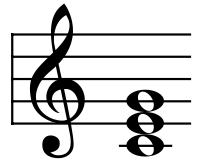
A power chord is a form of 2-note chord, consisting of the root note and a perfect 5th. The chord formula for a power chord is 1 - 5 (1st & 5th)
The most common chords are triads — three‑note chords that are usually major, minor, suspended, augmented, or diminished. These basic chords can be extended by adding notes to form seventh, ninth, eleventh, and thirteenth chords.
Chords are generally classed by their root note; so for example, a C chord is built upwards from the keynote of C.
Music Notes & Chords
Music Chords have collective names, depending on the number of notes in the chord:
- Dyad - 2 note chord
- Triad - 3 note chord (most common)
- Tetrad - 4 note chord
- Pentad - 5 note chord
- Hexad - 6 note chord
Stacking Thirds
Most chords are built by stacking thirds—either major thirds or minor thirds.- A major third is equal to 4 half steps or 4 semitones
- A minor third is equal to 3 half steps or 3 semitones
Let's take a closer look at the 4 common triads, and the intervals that define them.
🔹 Major
🔹 Minor
🔹 Diminished
🔹 Augmented
The following example is in C major and uses a chromatic scale, showing the notes in half‑steps — the shortest distance between notes.
1. Major Triad = Major third + Minor third
🎶C - C# - D - D# - E - F - F# - G
- C → E = 4 half‑steps (major third)
- E → G = 3 half‑steps (minor third)
- C–E–G form the C major triad.
- C → G = 7 half‑steps (perfect fifth)
2. Minor Triad = Minor third + Major third:
🎶C - D♭ - D - E♭ - E - F - G♭- G
- C → E♭ = 3 half‑steps (minor third)
- E♭ → G = 4 half‑steps (major third)
- C–E♭–G form the C minor triad.
- C → G = 7 half‑steps (perfect fifth)
3. Diminished Triad = Minor third + Minor third:
🎶C - D♭ - D - E♭ - E - F - G♭
- C → E♭ = 3 half‑steps (minor third)
- E♭ → G♭ = 3 half‑steps (minor third)
- C–E♭–G♭ form the C diminished triad.
- From C - G♭ = 6 half‑steps (diminished 5th)
4. Augmented Triad = Major third + Major third:
🎶C - C# - D - D# - E - F - F# - G - G#
- C → E = 4 half‑steps (major third)
- E → G# = 4 half‑steps (major third)
- C-E-G# form the C augmented triad.
- From C → G# = 8 half-steps (augmented 5th)
Stacking More Thirds
When you stack another third on top of a triad, you create a 7th chord — such as a dominant 7th or major 7th, depending on the intervals.- Add another third, and it becomes a 9th chord (dominant 9th or major 9th).
- Add another, and you form an 11th chord.
- Add one more, and you reach a 13th chord.
- That’s a whole lot of stacking!
Understanding how chords are built by stacking thirds is essential when working with intervals. Once you grasp how triads are formed using major and minor thirds, you’re already well on your way to understanding the intervals used in more complex chords. C'mon, you're doin' great! 💪

Chord Composition
In popular music, a music chord is composed of several parts:
- The root note
The foundational pitch on which the chord is built.
Example: C - The chord quality (type)
Describes the structure created by the 3rd and 5th.
Examples: major, minor, suspended, augmented, diminished - The Interval Numbers
Indicate which scale degrees above the root are included.
Examples: 3rd, 5th, 7th - Altered intervals
Specific scale degrees modified with accidentals.
Examples: ♭3, ♯5, ♭7 - Added tones
Adds an extra note without forming a full extended chord.
Examples: Dadd4, Cadd9, C⁄9
Commonly Used Triads:
Triads are three-note chords made up of the 1st, 3rd, and 5th notes of a scale. The four basic types of triads are major, minor, diminished, and augmented.
The following chart is based on the C Major Scale:
C - D - E - F - G - A - B
| Chord Type | 3rd Interval | 5th Interval | Chord | Notes |
|---|---|---|---|---|
| Major Triad (C) | Major 3rd | Perfect | C, CM, CΔ, Cma, Cmaj | C – E – G |
| Minor Triad (Cm) | Minor 3rd | Perfect | Cm, C-, Cmi, Cmin | C – E♭ – G |
| Augmented Triad (C+) | Major 3rd | Augmented | C+, Caug | C – E – G♯ |
| Diminished Triad (Cº) | Minor 3rd | Diminished | Cº, Cm(♭5), Cdim | C – E♭ – G♭ |
Commonly used 7th Chords:
Seventh chords, or tetrads, are four-note chords that include the 1st, 3rd, 5th, and 7th notes of a scale. They are formed by adding a fourth note to a triad (a three-note chord). This additional note is a third above the fifth of the triad, creating an interval of a seventh above the root of the chord.
The following chart is based on the C Major Scale:
C - D - E - F - G - A - B
| Chord Type | 3rd Interval | 5th Interval | 7th Interval | Chord | Notes |
|---|---|---|---|---|---|
| Dominant 7th | Major 3rd | Perfect | Minor | C7, Cdom7 | C – E – G – B♭ |
| Minor 7th | Minor 3rd | Perfect | Minor | Cm7, Cmin7, C–7 | C – E♭ – G – B♭ |
| Major 7th | Major 3rd | Perfect | Major | Cmaj7, CM7, CΔ7 | C – E – G – B |
| Minor major 7th | Minor 3rd | Perfect | Major | CmM7, Cm(maj7), Cm(Δ7) | C – E♭ – G – B |
| Augmented 7th | Major 3rd | Augmented | Minor | C+7, Caug7, C7♯5, C7+5 | C – E – G♯ – B♭ |
| Augmented major 7th | Major 3rd | Augmented | Major | C+Δ7, C+maj7, Caug(maj7) | C – E – G♯ – B |
| Diminished 7th | Minor 3rd | Diminished | Diminished | Cº7, Cdim7 | C – E♭ – G♭ – B𝄫 |
| Half-diminished 7th | Minor 3rd | Diminished | Minor | Cø7, Cm7♭5, C–7(♭5) | C – E♭ – G♭ – B♭ |
Extended Chords - 9th, 11th & 13th chords
Extended chords build on triads (three-note chords) by adding additional notes beyond the 7th. These extensions include 9th, 11th, and 13th chords. Notes added beyond the 13th typically repeat notes that are already present in the chord.The following will help to explain this.
- A 9th is like a suspended 2nd (sus2) but the 2nd is played an octave higher.
C - D - E - F - G - A - B♭ - C - D - An 11th is like a suspended 4th (sus4) but the 4th is played an octave higher.
C - D - E - F - G - A - B♭ - C - D - E - F - A 13th is like a 6th but the 6th is played an octave higher.
C - D - E - F - G - A - B♭ - C - D - E - F - G - A
A 3rd above the last A on the 13th chord (A - B - C) will take you back to C (the root or tonic)... we start all over again so there is no point in going any further with 15th's, 17th's etc.
In summary, triads, 7th's, 9th's, 11th's, and 13th's take care of every note in a given music scale.
The following chart is based on the C Major Scale:
C - D - E - F - G - A - B
| Chord Type | 3rd, 5th, 7th Interval | 9th | 11th Interval | 13th | Chord | Notes |
|---|---|---|---|---|---|---|
| Dominant 9th | dominant 7th chord | Major | – | – | C9 | C – E – G – B♭ – D |
| Dominant 11th | dominant 7th chord | Major | Perfect | – | C11 | C – E – G – B♭ – D – F |
| Dominant 13th | dominant 7th chord | Major | Perfect | Major | C13 | C – E – G – B♭ – D – F – A |
Notice that 9th, 11th and 13th chords are built on dominant 7th chords where the 7th degree of the scale is flattened. Also notice that,
- a 9th chord can be written as
C7add9 or C7/9 (notes are C - E - G - B♭- D)
not Cadd9 or C/9... where the notes are C - E - G - D - an 11th chord can be written as C9 add11 or C9/11 (notes are C - E - G - B♭- D - F)
- a 13th chord can be written as C11 add13 or C11/13 (notes are C - E - G - B♭- D - F - A)
Suspended Chords
A sus chord or suspended chord is a 3 note chord or triad where the 3rd is omitted. This is replaced with a major 2nd or a perfect 4th. It is a music chord having a root, a major 2nd or perfect fourth (no third), and a perfect fifth. This results in two main chord types:
- the suspended second (sus2) - a Major 2nd is 2 half-steps or semitones upwards from the root or tonic
- the suspended fourth (sus4) - a Perfect Fourth is 5 half-steps or semitones upwards from the root or tonic
For example:
Csus2 consists of the notes C–D–G
Csus4 consists of the notes C–F–G
Take Note
- When counting upwards from a note, don't include the first note, e.g., a major 3rd is 4 half- steps upwards from the tonic or root:
A major 3rd (four half-steps) from C is E:
C - C# - D - D# - E.
We count upwards from C, not counting C - When we talk about intervals or notes in a scale or chord, we refer to them as the 3rd, 5th, 7th notes etc. In these cases, we include the tonic or root note when counting.
The 5th note of a C Major scale or chord is G:
C – D – E – F – G (C or first note is included in the count).