A Major Chords for Guitar
A - C# - EA Major chords consist of the 1st, 3rd, and 5th notes of the A Major Scale. We have chosen 3 popular positions using horizontal charts displaying a natural playing position.
- Construction: root, major third, perfect fifth
- A Major Scale: A - B - C# - D - E - F# - G#
- Chord: A (A△)
- Formula: 1 - 3 - 5
- Notes: A - C# - E (result from applying the formula to the A Major Scale)
A - A major (1-3-5)
Spelling: 1st(A), 3rd (C#), 5th(E)▶︎ Chart Legend
Numbered Circles: number inside circle indicates which finger to use
X: Don't play string
White Numbered Circles: Optional Notes
X on string with optional note: if you omit the note, don't play string
Unmarked strings: Play open
Barre Line: One finger holds down multiple strings
R: Root Note
TAB: Numbers represent frets - not finger positions
Blank Strings: Do not Play
0: play string open
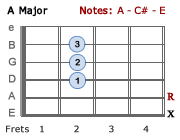
Written: x02220
Notes: x-A-E-A-C#-E
Form/chord shape: A
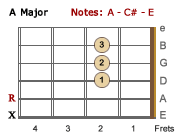
TAB
e |-0-|
B |-2-|
G |-2-|
D |-2-|
A |-0-|
E |---|
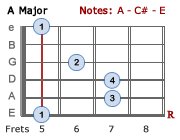
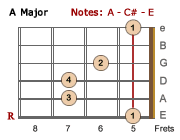
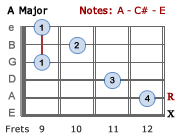
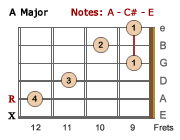
↓ A major guitar chords
Why don't we play the bottom E in the A major chord - 1st position?
Before we start, it must be said that most chords lead with the root or tonic of a chord.Technically speaking, you can play the bottom E, because E is part of an A chord, although it tends to 'drown out' the true essence of the chord in terms of sound... why?
A major chords are made up of the notes A - C# - E (1st - 3rd - 5th). If we look at the scale degrees of a chord, we have the tonic (1st scale degree), the mediant (3rd scale degree), and the dominant (5th scale degree).
The strongest note in any diatonic triad (3-note chord), is the tonic (1st note), and the second strongest is the dominant (5th note), with the mediant (3rd note), the most 'delicate' or 'easily overwhelmed' of the three.
It must also be said that the third note (mediant) determines whether or not a chord is major or minor, so it does have a distinct presence within a chord. The 3rd (C#) is the 'flavor' of the chord. While we need it to know the chord is Major, having too many of them—especially in lower registers can make the chord sound 'cluttered' or muddy. Keeping a higher ratio of Roots and 5ths keeps the chord sounding powerful."
It's always nice to start any chord on the tonic or root note as this sets the tone for the chord. If that isn't possible, the next best note to start a chord would be the dominant or 5th note, making sure there is a fairly even balance between tonic and dominant notes. It's interesting to note that these 2 notes make up power chords, as they are the strongest notes in a diatonic scale.
The next thing you need to look at, is how many times you are playing the notes (A - C# - E) in the chord. If you were to play A major including the bottom E string and strumming downwards, the chord would read, E - A - E - A - C# - E. Notice how many E's there are along with their positioning... 2 tonics, 1 mediants, and 3 dominant... top, center, and bottom. In this case, there are too many dominants in the chord with a tendency to 'over-power' it. Because the low E is the deepest note, our ears hear it as the 'foundation.' This makes the chord feel 'upside down' or unresolved, rather than solid and grounded on the A."
Removing one of the dominants and starting the chord on the tonic or root note, resolves this situation leaving us with a chord that sounds right... A - E - A - C# - E, i.e., 2 tonics, 1 mediant, and 2 dominants... a more balanced mix.
Try it for yourself... strum down on all 6 strings including bottom E, and then do the same, except this time omitting the bottom E, and start on the 5th string (A). Notice the difference in sound...
What about the other positions:A - 2nd position has a 3:1:2 ratio leading with the tonic which is great.
A - 3rd position has a 2:2:1 ratio without the optional note which is fine, however there is room for another E or dominant note which is optional - fret 12, bottom string.
Because there are 2 tonics (A) and 2 mediants(C#), there is room for another dominant (E), without effecting the true nature of the chord... it makes for a fuller sounding chord due to the even balance of notes, i.e., 2:2:2 ratio with all the notes in close proximity. If you don't play the optional note, don't play the open E as it is too distant from the other notes, and being a dominant note, overpowers the sound of the chord.
PS. If you do play the A chord in the 3rd position, you should pat yourself on the back. Without the optional note, it takes some getting used to, and with the optional note it becomes very difficult as your 4th finger has to cover the bottom 2 strings... good luck.
It must be said that each chord has to be treated on it's own merit. You may want to play the bottom E string on an A chord because you are after a particular sound. This is usually written as A/E which means an A chord leading with an E bass note, and is also the 2nd inversion of A major. You will also find that some chords have more dominant notes than tonics, and sound fine, e.g. B♭ major 1st position barre chord with the optional note added has a ratio of 2:1:3... your ears always have the answer.
Cheat Sheet Table
| Chord Version | Notes (Low to High) | Ratio (T:M:D) | Character & Sound |
|---|---|---|---|
| Standard A (5-String) | A - E - A - C# - E | 2 : 1 : 2 | Balanced, clear, and grounded. Perfect for most songs. |
| A/E (6-String) | E - A - E - A - C# - E | 2 : 1 : 3 | Heavy and "unresolved." The low E can overpower the Root. |
| A Power Chord | A - E - A | 2 : 0 : 1 | Neutral, strong, and "punchy." No "flavor" (3rd) included. |
The "Golden Balance" of Chords
When you are building your own chords or deciding which strings to strum, keep these three "Golden Rules" in mind to ensure your guitar sounds professional and clear:- Lead with the Root: Whenever possible, start your strum on the Tonic (1st). This anchors the sound and tells the listener exactly what chord they are hearing.
- The 5th is Support: The Dominant (5th) adds power, but too many of them, especially in the bass, can "overpower" the chord and make it sound top-heavy or unresolved.
- The 3rd is Flavor: The Mediant (3rd) defines whether the chord is Major or Minor. You only need one or two to get the point across; too many (or playing them too low on the neck) can make the chord sound "muddy."
- The Ear Test: If a chord sounds "off" or "blurry," count your notes. Aim for a healthy ratio where the Tonic and Dominant provide the foundation, and the Mediant provides the color. If it sounds good, it is good, but when in doubt, let the Root note lead the way! 🥳