Beginners Music Theory
An Introduction to Written MusicAlready familiar with the basics? You may prefer our more detailed page: Basic Theory for Beginners.
This page is a gentle, friendly introduction to the basics of written music. It’s designed especially for absolute beginners — people who have never read music before, children learning with parents, anxious learners, and anyone who wants a soft, confidence‑building start.
You don’t need to know anything before you begin. Each idea is explained simply, with diagrams, guitar-based examples, and small “Try It Yourself” moments to help you learn at your own pace.
- You don’t need to memorize everything.
- Learning music theory is like learning a new language — it becomes clearer with time.
- Feeling unsure at first is completely normal. Every small step counts.
⭐ What You’ll Learn:
- pitch
- notes
- staff / stave
- rests
- clefs
- ledger lines
- measures
- time signatures
- key signatures
- accidentals
1. What Is Pitch?
Pitch is how high or low a sound feels.- A bird singing has a high pitch.
- A growling bear or a bass drum has a low pitch.
Try It Yourself: Say “ooooh” in a high, squeaky voice. Now say it in a deep, low voice. You’ve just changed pitch!
Guitarists:- High Pitch: The thin, high E string (the 1st string closest to your feet).
- Low Pitch: The thick, low E string (the 6th string closest to your chin).
2. What Is a Musical Note?
Now that we know about pitch (high and low sounds), how do we actually write those sounds down so someone else can play them?We use symbols called musical notes.
Think of a musical note as a written instruction. Every single note tells your hands and eyes two simple things:
- Which sound to play (the Pitch).
- How long to hold that sound (the Duration).
On a page of music, notes look like little oval shapes or a colored-in circle, often with a straight stem attached to them.
Commonly used notes:| Note | Name | Duration |
|---|---|---|
| 𝅝 | Whole Note | 4 beats |
| 𝅗𝅥 | Half Note | 2 beats |
| 𝅘𝅥 | Quarter Note | 1 beat |
| 𝅘𝅥𝅮 | Eighth Note | 1⁄2 beat |
| 𝅘𝅥𝅯 | Sixteenth Note | 1⁄4 beat |
🎸 The Guitar Connection
If you pick up your guitar and pluck the open A string, you have just played a note. The physical sound coming out of your guitar is the note, and the little symbol we write on the page represents that exact moment.
Guitarists:Try It Yourself: Pluck a single string on your guitar and count 1, 2, 3, 4 while it rings out. You just played a note with a duration of four beats!
3. The Music Staff / Stave
Music is written on a grid called a staff (or stave) — which is made of five lines and four spaces. We always count them from the bottom to the top.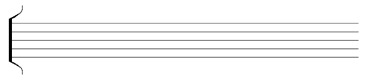
- Notes placed higher on the staff sound higher.
- Notes placed lower on the staff sound lower
4. Clefs
A clef is a symbol placed at the very beginning of the staff. It acts like a key that tells you exactly which musical notes belong on which lines.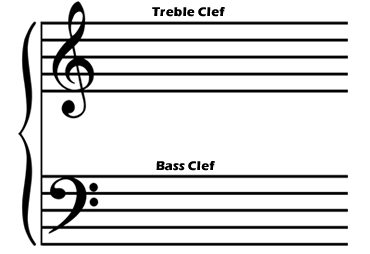
- Treble Clef: Used for higher notes (singing voices, violin, flute, and the guitar).
- Bass Clef: Used for lower notes (the left hand of the piano, bass guitar, and cello).
Notes on the Treble and Bass Clefs:
All notes are read from bottom to top along with sayings to help you remember them.
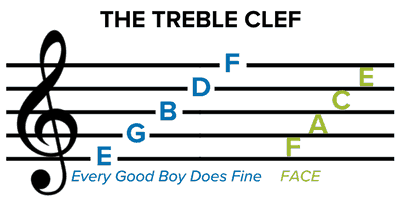
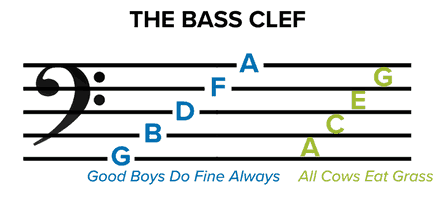
Guitarists: Guitar players rarely—if ever—have to read the Bass Clef.
- Treble Clef: This is the only clef you need to worry about for standard guitar playing. All guitar music and lead sheets are written in the treble clef.
5. Notes & Rests (Sound vs. Silence)
Written notes tell your hands or voice two things: which note to play (pitch) and how long to hold it (duration). Rests tell you exactly how long to be completely silent.- Whole Note (𝅝): Looks like an open circle. It lasts for 4 beats.
- Half Note (𝅗𝅥): An open circle with a stem. It lasts for 2 beats.
- Quarter Note (𝅘𝅥): A filled in circle with a stem. It lasts for 1 beat.
Try It Yourself: Tap your foot steadily: 1, 2, 3, 4. Now, clap only on count 1 and let it ring. You just played a whole note. Now clap on every single count. Those are quarter notes.
The same principal applies to rests:- Whole Note Rest: Silence for 4 beats.
- Half Note Rest: Silence for 2 beats.
- Quarter Note Rest: Silence for 1 beat.
Notes vs. Rests: Where Do They Go?
When learning to read music, it helps to understand how notes and rests use the staff differently.
1. Musical Notes Move Up and DownNotes can appear on any line or space of the staff (and even on ledger lines above or below it).
- Why? The vertical position of a note tells the musician its pitch (how high or low it sounds). Because music has many different pitches, notes must be free to move anywhere.
2. Rests Stay in Fixed "Homes"
Unlike notes, rests usually stay in the exact same spot on the staff.
- Why? Since a rest indicates silence, it doesn't have a pitch. Instead, rests have designated "homes" so musicians can recognize them instantly.
The following table includes the most commonly used notes and rests. Notice the inclusion of the eighth-note and the sixteenth-note and their related rests. Take special note of how the rests appear on a Music Staff.
Most Commonly used Notes and Rests:| Notes | British Name | Note Value | American Name | Rests |
|---|---|---|---|---|
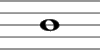 |
Semibreve | 4 | Whole Note | 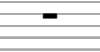 |
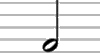 |
Minim | 2 | Half Note | 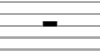 |
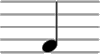 |
Crotchet | 1 | Quarter Note |  |
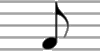 |
Quaver | 1/2 | Eighth Note | 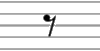 |
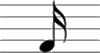 |
Semi-quaver | 1/4 | Sixteenth Note | 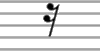 |
Beginner Memory Tips:
- Whole Note Rest (4 beats): Hangs down from the 4th line. Looks like a hole in the ground (or an upside-down hat).
- Half Note Rest (2 beats): Sits on top of the 3rd line. Looks like a hat sitting on someone's head.
- Quarter Note Rest (1 beat): Centered right in the middle of the staff. Spans across lines 1 to 4 like a lightning bolt.
- Eighth Note Rest & Sixteenth Note Rest: Centered on the middle lines. Their "heads" sit neatly in the spaces.
6. Ledger Lines
What happens if a note is too high or too low to fit on the five lines of the staff?
We draw small, temporary extra lines just for that note. These are called ledger lines. Think of them like extension steps on a ladder. This keeps everything perfectly aligned so your eyes can easily track how low or high the pitch is going.
Guitarists encounter ledger lines almost immediately because our instrument naturally plays lower than the standard staff lines.
7. Measures, Time Signatures and Key Signatures
1. Measures: To make music easier to read, it is divided into small, equal blocks using vertical lines. These blocks are called measures or bars.
2. Time Signatures: At the very start of the music, you will see two numbers stacked on top of each other (like 4/4). This is the time signature:- Top Number: Tells you how many beats are in each bar.
- Bottom Number: Tells you what kind of note counts as one beat.
3. Key Signatures: Instead of writing a sharp or flat symbol next to every single note across the whole page, composers put a small group of sharps or flats at the very beginning of the line. This is the key signature, and it tells you which notes to keep sharp or flat for the entire song.
Let's Recap: The following diagram is a quick guide on what you will generally find on guitar music and lead sheets. In this example there are 4 measures or bars, indicated by the red numbers.
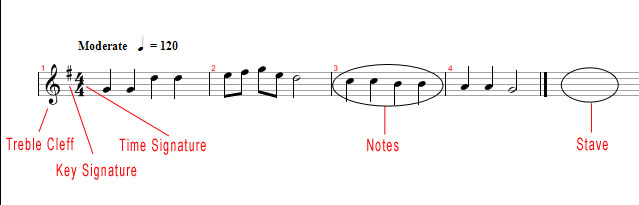
Moderate 𝅘𝅥 = 120: This indicates a moderate tempo of 120 beats per minute — generally used with a metronome or click track to keep accurate time.
8. The Musical Alphabet
Unlike the English alphabet, the musical alphabet only uses seven letters:Once you reach G, you don't run out of notes—the alphabet simply loops back to the beginning and starts over again at A (just at a higher pitch). This is referred to as an Octave.
Meeting Your StringsAs a guitarist, you already know most of the musical alphabet just by tuning your instrument. If you line your guitar strings up from the thickest (lowest pitch) to the thinnest (highest pitch), you get a classic phrase many players use to memorize them:
Eddie Ate Dynamite, Good Bye Eddie.
- 6th String (Thickest): E
- 5th String: A
- 4th String: D
- 3rd String: G
- 2nd String: B
- 1st String (Thinnest): e
To see the musical alphabet in action, imagine you are playing the E string (the 6th string) open. If you press down on each fret, one by one, you are just walking forward through the alphabet with the occasional sharp or flat added depending on the fret the string is played on.
- Open String (No frets): E
- 1st Fret: F (The half-step in between)
- 2nd Fret: F#/Gb
- 3rd Fret: G (Notice there is no sharp between E and F)
- 4th Fret: G♯ / A♭
- 5th Fret: A
Try It Yourself: Go to the 6th String (Low E) on the Fretboard Explorer widget above. Click Open, then click Fret 1, Fret 3, and Fret 5. You just spelled out the letters E - F - G - A.
9. Accidentals (Sharps, Flats, & Naturals)
Sometimes we need to play the notes "in between" the main alphabet letters (like the black keys on a piano). We alter the notes using accidentals:- # Sharp: Raises the pitch just a tiny bit higher.
- ♭ Flat: Lowers the pitch just a tiny bit lower.
- ♮ Natural: Cancels out a sharp or flat and returns the note to normal.
Guitarists:
- Sharp (#): Move up one fret toward the guitar body.
- Flat (♭): Move down one fret toward the tuning pegs.
Please Note:
- A half-step or semitone on a guitar fretboard = 1 fret
- A full-step or tone on a guitar fretboard = 2 frets
So far so good...
If you’ve made it this far, give yourself a huge pat on the back! Learning to read music is like learning a beautiful new language—it’s completely normal if some of it feels a bit mysterious at first. Take your time, let these ideas settle, and practice at your own pace.
Ready to go further?Explore Basic Theory for Beginners to strengthen your foundations, or head back to our main Music Theory page to explore more detailed guides on your favorite topics. You've got this!.