Basic Theory for Beginners
This section on Basic Theory is an introduction to those of you that have had little or no experience in music.
Firstly we take a look at all the elements that make up 'music'... notes, clefs, staffs, rests, intervals, accidentals, time signatures, key signatures, etc., and then we look at how these elements interact and create musical expression. In any field of study there is information we need to learn and apply, certain rules we need to follow, and even formulas to help us along the way.
Music theory helps us to understand the music, along with its elements, principles, applications, rules, formulas, etc., and once we understand the music, we are better prepared to create the music. We will start with the very basics.
Pitch - Sound - Notes - Staffs - Clefs
Pitch is how low or how high sound is placed. In musical terms, pitch is associated with the frequency of a sound wave. A higher frequency produces a higher pitch (perceived as a higher note), while a lower frequency produces a lower pitch (perceived as a lower note).
In music, pitch is fundamental as it determines the specific notes or tones produced by musical instruments or voices. The arrangement of different pitches in a sequence creates melodies, harmonies, and musical compositions.
Sound is shown on the piano for example by keys. It is shown on music by printed characters called notes.
Musical Notes: In written music notation, characters called "notes" are used to represent the pitch and duration of sounds. Notes are placed on a staff (a set of horizontal lines and spaces) to indicate different pitches. The position of a note on the staff determines its pitch, and the shape and style of the note indicate its duration.
- Noteheads: The shape of the notehead (oval, filled or open) indicates the duration or length of time that the note is held
- Note Placement on the Staff: The vertical position of a note on the staff determines its pitch. Higher notes are placed higher on the staff, and lower notes are placed lower.
Notes are named after the first seven letters of the alphabet:
A - B - C - D - E - F - G
They are given pitch position by being placed on 5 lines and 4 spaces called a Staff or Stave.
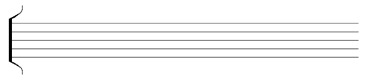

Two Staffs are in general use:
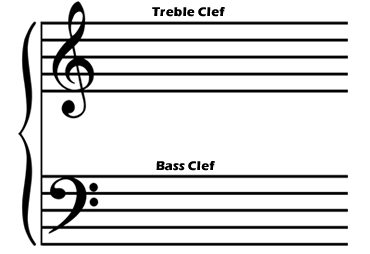
- One for the low sounds played by the left hand on a piano called the Bass or F Clef
- One for the high sounds played by the right hand on a piano called the Treble or G Clef
Clefs
A Clef is a sign placed at the beginning of every Staff of music to give definite pitch position and an alphabetical name to all the notes placed on it. Without a Clef, we don't know what the note names are and how high or low the notes will sound.
The top Clef is the Treble or G Clef - The bottom Clef is the Bass or F Clef.
Every Clef tells us the pitch of any note placed on it, e.g., In the diagram below G4 on the Treble Clef is at the exact same position of B2 on the Bass Clef but the notes are different. One is a G note and one is a B note.
Diagram 1.

Treble Clef or G Clef - G line (G4) passes through the center of the curl.
Bass Clef or F Clef - the F line (F3) passes between the 2 dots.
- The treble clef and bass clefs are the most commonly used clefs in modern music with the C clefs used to a lesser degree.
- MC stands for Middle C, the grandfather note. It is placed on the first ledger line above the bass clef or the 1st ledger line below the treble clef. (They are the same note) See C4 above.
- Ledger lines are the short lines used above and below the staffs upon which notes are placed when they are too high or too low to be put on the Staffs. (In Diagram 1, this is represented by C4 on the Treble Clef and E2 on the Bass Clef)
- When you go from a given note name to another note of the same name, you pass through seven different names plus the repeated one. This is 8 notes in all and is called an Octave.

Over the centuries little sayings have been invented to help us remember the notes on the Treble and Bass Clef. The first letter of each word represents the note.
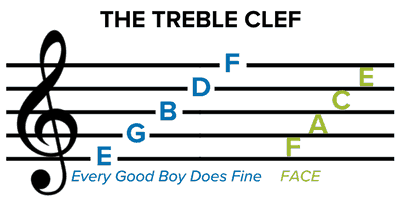
Treble Clef: The notes on the lines are E G B D F from bottom to top:
Every Good Boy Deserves Fruit
Treble Clef: The notes in the spaces are F A C E from bottom to top:
FACE
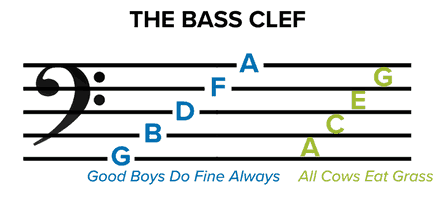
Bass Clef: The notes on the lines are G B D F A from bottom to top:
Good Boys Do Fine Always.
All Cows Eat Grass
General Music Notation:
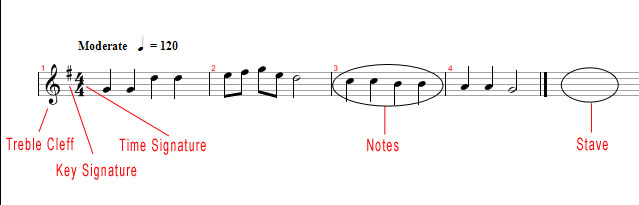
The time signature indicates the relationship between timing counts and note symbols, while the bar lines group notes on the staff into measures.
Bar Lines
Bar Lines are used to separate measures. They are also extended to connect the upper and lower staffs of a grand staff.

Bar lines are vertical lines drawn across the staff in sheet music, dividing the music into measures or bars. These lines help organize the musical notation into rhythmic and metrical units.
The placement of bar lines is determined by the time signature indicated at the beginning of the piece of music. The time signature defines the number of beats in each measure and the type of note that receives one beat.

Single Bar Lines: This is the most basic type, signifying the end of a measure.
𝄀 𝄀 𝄀 𝄀
Double Bar Lines : Used to separate two sections of music. Also used at changes in key signature, time signature or major changes in style or tempo.
𝄁 𝄁 𝄁 𝄁
Dotted Bar Lines : Used to subdivide long measures into shorter segments for ease of reading.
𝄇 When double bar lines have dots placed before them, it means that the section just played or sung is to be repeated.
𝄆 If the dots are placed after the double bars, the section ahead is to be repeated.

In this example, the section between the dots is to be repeated... more on repeat signs.
𝄂 Final (End) Bar Line: Used to indicate the conclusion of a movement or an entire composition.
Bars are not always the same length by ruler-measurement, but each bar of a piece contains the same number of beat counts. This is shown by the time signature at the beginning of the piece.
Download a free chart on all the lines in music, including bar lines.
Notes & Rests
Parts of a Note

The length value of note sounds is indicated by the shape of the notes. This includes the note head, the stem, and the flags, hooks or beams. The shape of the head, and the absence or presence of the stems and flags, all indicate the duration of the note.
There are 6 shapes in general use and three shapes not used very much.
↓ notesThe 6 notes in general use are:
- Whole Note - Semibreve 𝅝
- Half Note - Minim 𝅗𝅥
- Quarter Note - Crotchet 𝅘𝅥
- Eighth Note - Quaver 𝅘𝅥𝅮
- Sixteenth Note - Semi Quaver 𝅘𝅥𝅯
- Thirty Second Note - Demi Semi Quaver 𝅘𝅥𝅰
The 3 notes not generally used are:

- Double Whole Note - Breve 𝅜
- Sixty Fourth Note - Hemi Demi Semi Quaver 𝅘𝅥𝅱
- One Hundred and Twenty Eighth Note - Semi Hemi-Demi-Semi-Quaver 𝅘𝅥𝅲 (You would really be pushing to play at this speed!)

- Notes represent sound
- Rests represent silence
- Each note has a rest of the same name (e.g., eighth note - eighth note rest)
- A whole-note rest may be used for a whole-bar rest at any time no matter how many beats are in each bar.
For example:
In a 4/4 time signature, which typically has four beats per measure, a whole-note rest occupies the entire measure and indicates silence for the entire duration of those four beats.
Similarly, in a 3/4 time signature where there are three beats per measure, a whole-note rest represents silence for the entire measure, encompassing the three beats.
The whole-note rest is a fundamental notation symbol used to indicate silence for a full measure, regardless of the specific rhythmic structure dictated by the time signature.
- Notes which have tails may be grouped instead of being left single (e.g., the eighth-note, sixteenth-note, thirty-second-note family etc. may all be grouped.
Most Commonly used Notes and Rests:
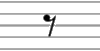
| Notes | British Name | Note Value | American Name | Rests |
|---|---|---|---|---|
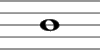 |
Semibreve | 4 | Whole Note | 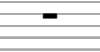 |
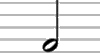 |
Minim | 2 | Half Note | 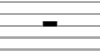 |
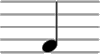 |
Crotchet | 1 | Quarter Note |  |
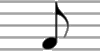 |
Quaver | 1/2 | Eighth Note For notes of this length and shorter, the note has the same number of flags (or hooks) as the rest has branches. |
 |
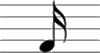 |
Semi-quaver | 1/4 | Sixteenth Note | 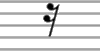 |
P.S. Note value indicates the relative duration of a note, e.g., the duration of an eighth note is ½ beat (½ of one beat); the duration of a sixteenth note is ¼ beat (¼ of one beat), etc.
↓ notes and restsThere are 3 ways to make notes and rests longer in value:
- Dot(s)
- Fermata, pause, or hold symbol
- Tie(s)

- Dotted quarter-note = 1 + ½ (1½) beats
- dotted half-note = 2 + 1 (3)beats
- dotted eighth-note= ½ + ¼ (¾) beats.
- Two dots after a note makes a note half plus a quarter longer in value 𝅘𝅥.. = 1 + ½ + ¼ beats = 1¾ beats
2. A fermata, pause, or hold symbol 𝄐 placed above or below a note lengthens it for an indefinite period according to the performer's preference.

3. A tie is a curved line over 2 or more notes of the same alphabetical name or pitch. The first note is sounded and sustained until the values of all the notes end. In this example the note is held for 1 + ¼ beats.
Rules regarding the stems of notes

- When notes are written from the lower part of the staff up to and on the third line, they usually have their stems placed on the right side of the note turning upwards with tails or flags down to the right.
- Notes written on the third line and above, usually have their stems placed on the left side of the note turning downwards with tails or flags up to the right.
- Tail always turn to the right
- Notes which have tails may be grouped instead of being left single, e.g., eighth-note, sixteenth-note, thirty-second-note family etc. may all be grouped.

I hope you have enjoyed this session on Basic Theory. Keep working at it. Always keep in mind that grasping the fundamentals is the first step toward mastering any skill. It's a universal truth—like many things in life, progress comes with patience and practice.
As you persist and consistently put in the effort, it all becomes second nature - your confidence grows and grows and before you know it, you'll find yourself excelling in the subject!
Always bear in mind that persistence and determination are invaluable qualities on the path to mastery, and remember... perseverance is GOLDEN.